What it means
On August 20, 2026, an AI model appeared for free on OpenRouter with no company name attached, labelled only ox-alpha. Within days it became the second busiest model there. Everyone asked who had made it, and the community guessed through technical fingerprints such as tokenizer patterns and code style. Their furthest guess: the GLM family, owned by the Chinese company Z.ai.
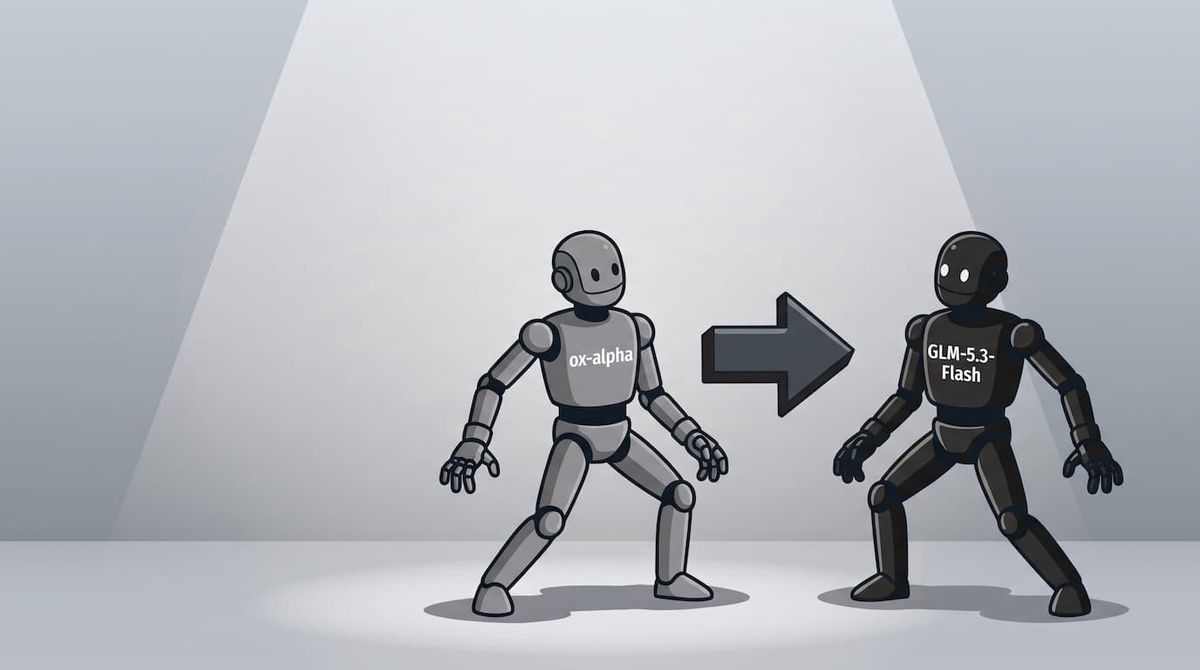
We took a different route. Instead of dissecting the machinery, we tested the model on language: 38 questions on Javanese speech levels, the kind that require picking the right respectful form for a particular listener. The same model, run twice, normally answers almost identically. Ox-alpha and the GLM-5.3 sold openly agreed on only 27 of those 38 questions.
Those 11 differing answers were the basis of what we wrote on August 24: ox-alpha was not the official GLM-5.3, though it was most likely still in the same family, perhaps a differently designed variant or a further round of tuning.
Two days later, on August 26, Z.ai announced that the mystery model was GLM-5.3-Flash, and admitted that it had been the one testing that model anonymously as ox-alpha. Exactly as we had guessed: one family, but not the same model.
Why it happened
Technical fingerprints answer the question "made by whom". They cannot answer "which one", because a company uses the same tokenizer patterns across its whole family. Language behaviour works the other way around: two models from the same factory still answer differently when their size and tuning differ, and that difference shows up most clearly on hard questions.
Javanese speech levels happen to be very hard questions. A model must know that the same word changes form depending on who is being addressed, and a small slip makes the answer wrong. Questions like that separate related models, while easy questions make them look like twins because both answer correctly.
The official figures make the rest clear. GLM-5.3-Flash carries 320 billion parameters, but only 18 billion of them actually work on any single answer, a frugal design built for speed. That explains why its score in our measurements sat slightly below the full GLM-5.3.
71.1
81.7
The red bar is higher on both question types, and the gap is similar in each. An identical model would not leave a pattern that steady, whereas two relatives with different working sizes would.
The limits
We never guessed the model's name, and we do not pretend otherwise. We concluded one thing only: it was not the official GLM-5.3. The name Flash came from Z.ai, not from our data.
That conclusion also rests on a single measurement per model, on one question type, in one regional language. Had those two models happened to answer similarly across those 38 questions, we would have concluded the opposite and been wrong. A 71 percent match sits far enough from the above-90 percent match typical of identical models, but it remains one piece of evidence rather than a body of it.
Finally, every figure here comes from our trial lane, a separate track for models that do not belong on the official leaderboard. Stealth models change identity too quickly to be ranked beside stable ones, so their scores are never recorded on ibahasa.com/benchmark. The data files are linked below this article.
Behind this finding
The technical version has the raw numbers, the test setup, and everything that cannot be concluded from them.